SPLENIC INJURY GRADING
Emergency Departmental Guide

Dr. Muzamil Sultan
Fellow of Royal College of Emergency Medicine, UK
Introduction
Developed by the American Association for the Surgery of Trauma (AAST), the grading system is based on CT features such as hematoma size, depth of laceration, presence of vascular injury, and the degree of splenic parenchymal disruption including a shattered spleen.
GRADE I : VERY MILD INJURY
Laceration
A small surface crack on the spleen.
It does not go deep into the organ.
Like a tiny scratch on an apple.

There are five grades of splenic injury Generally, grades I and II are considered
as minor injuries, grade III as a moderate injury, and grades IV and V as severe
injuries
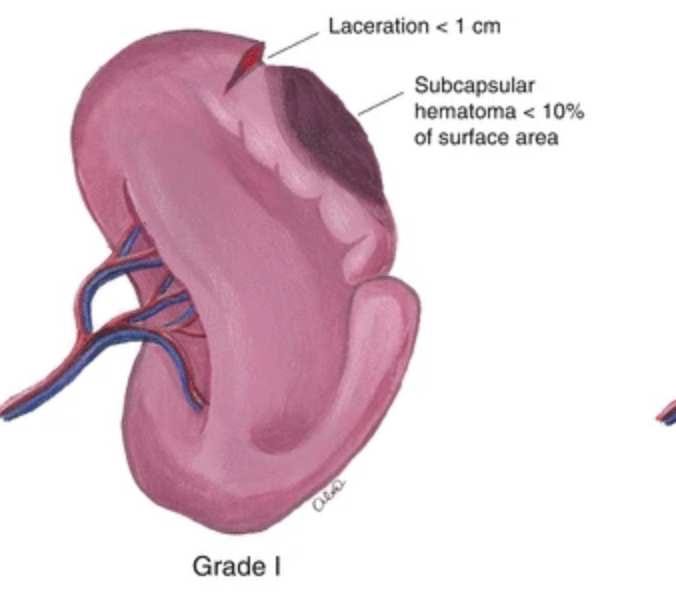
Subcapsular hematoma <10%
A small blood collection under the outer capsule of the spleen.
Capsule remains intact (not broken).
Less than 10% of the spleen surface is bruised.
Imagine a small bruise under the skin of the apple.
Points to Remember
Minimal crack
Small bruise
Capsule intact
Usually, no surgery needed
Very high success with non-operative management
GRADE II: MILD INJURY
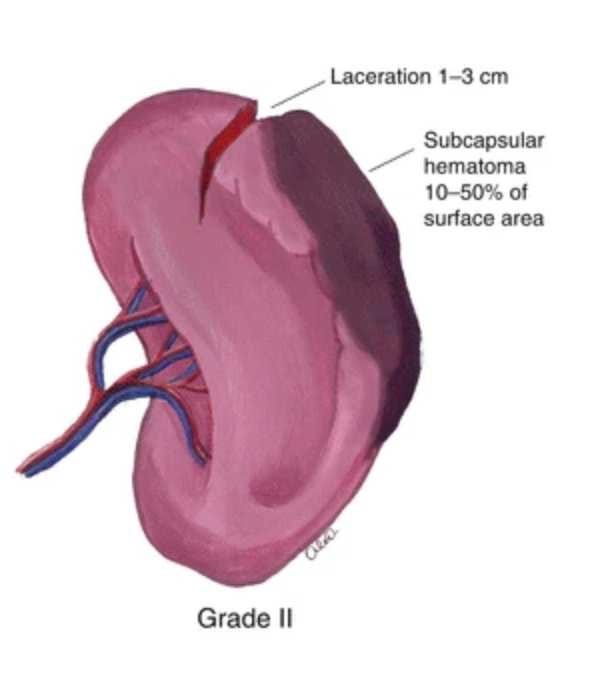
Laceration
Deeper cut → 1–3 cm
Bigger bruise → 10–50% of spleen surface
Still capsule intact
Subcapsular hematoma 10–50%
A bigger bruise under the spleen’s outer capsule.
It covers 10% to 50% of the spleen surface.
The capsule is still intact — it has not torn open.
Grade II = a medium-depth cut + medium-sized bruise. The spleen is still stable and not leaking major blood.
GRADE : III MODERATE INJURY
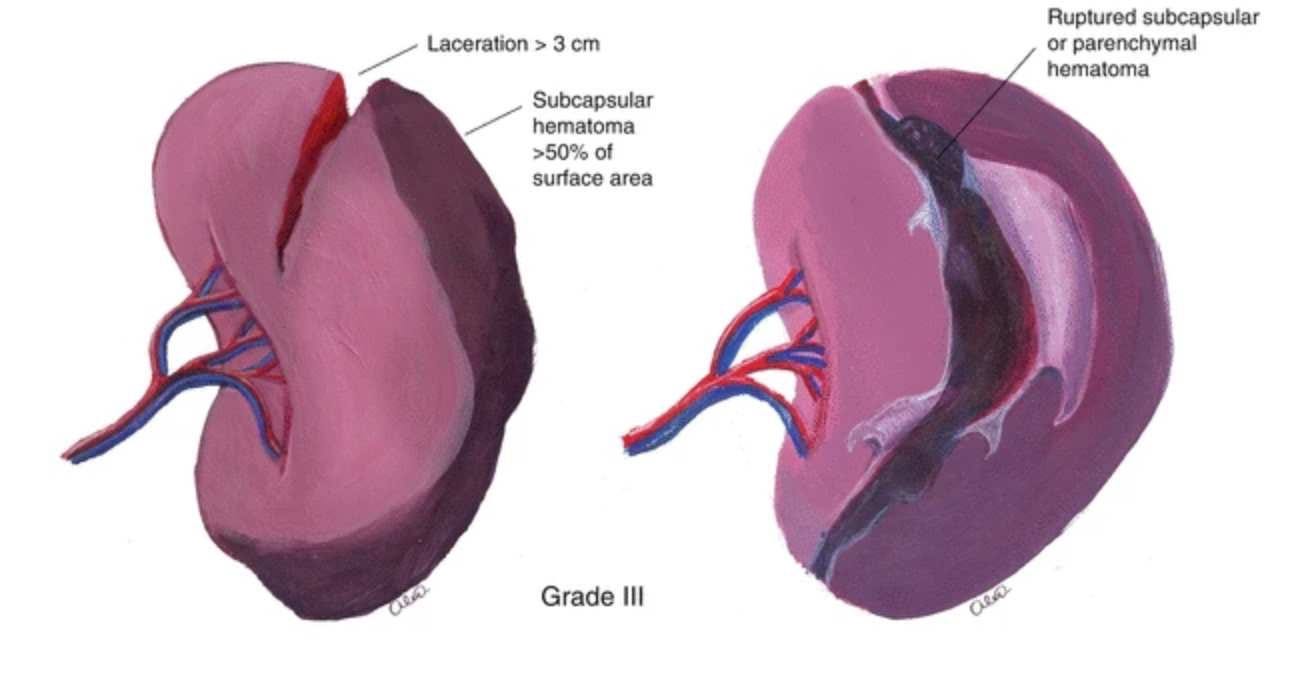
Cut >3 cm deep
Or large bruise >50% of surface
Or intraparenchymal hematoma >5 cm
Ruptured subcapsular or parenchymal hematoma
• The bruise has burst open,
o Blood is starting to leak out, OR
o The bleeding extends inside the spleen tissue.
• This shows the spleen is starting to lose control of the bleeding.
GRADE : IV HIGH RISK INJURY
Segmental or hilar vascular injury
A major splenic blood vessel is damaged.
These are the vessels that supply large parts of the spleen.
When they are injured, blood flow drops sharply.
Devasculariza9on > 25% of spleen
More than one-quarter of the spleen loses blood flow.
That part is basically not alive or not functioning anymore.
Shows significant injury to the splenic circulation.
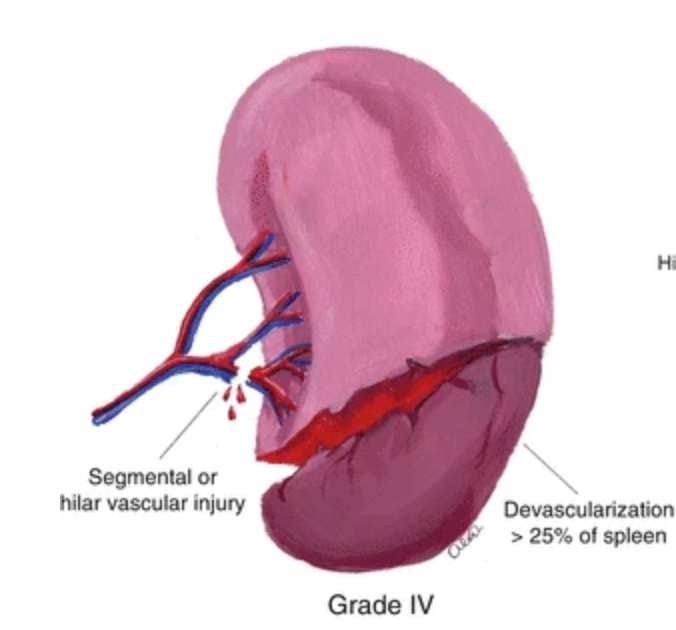
Grade IV = major vessel cut + a large area of spleen not ge?ng blood (>25%). Most cases need angioembolizaGon
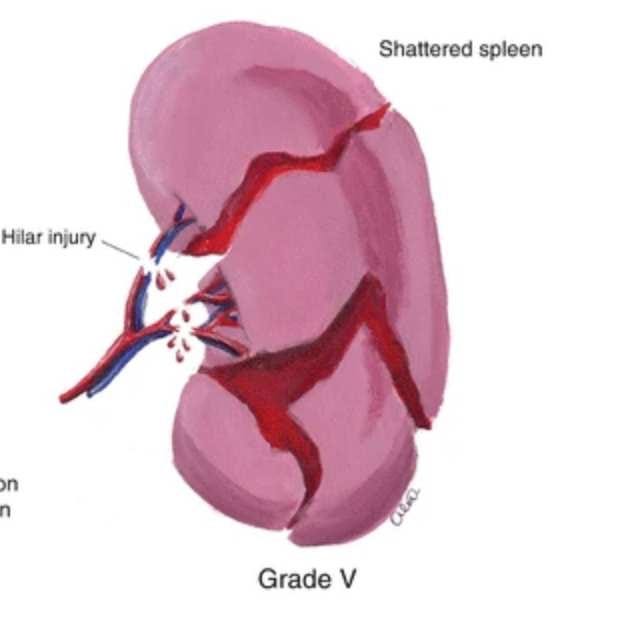
GRADE V : VERY HIGH RISK INJURY
Hilar injury
The main blood supply to the spleen (the hilum) is severely damaged or torn.
This is the area where the splenic artery and vein enter.
When this is injured, blood flow to the entire spleen stops.
ShaAered spleen
The spleen is broken into multiple pieces.
It is no longer one solid organ.
Massive bleeding risk.
Grade V = the spleen’s main blood supply is destroyed + the spleen is broken into pieces. This is the worst and most severe type of splenic injury.
1. Almostalwaysrequiressurgery(splenectomy) 2. Non-operativemanagementisextremelyunlikely 3. Representsmassivehemorrhagescenario
References :
Moore EE, Shackford SR, Pachter HL, et al. Organ injury scaling: spleen, liver, and kidney.
Journal of Trauma. 1989;29(12):1664–1666.
Barquist ES, Pizano LR, Feuer W et al (2004) Inter-and intrarater reliability in computed axial
tomographic grading of splenic injury: why so many grading scales? Trauma 56:334–338
University of Southern California, 1510 San Pablo St., 90033, Los Angeles, CA, USA Demetrios Demetriades (Professor of Surgery, Director of Trauma and SICU)
Publisher NameSpringer, Berlin, Heidelberg
